If you’ve been living with chronic neck and back pain, permanent grooves in your shoulders from bra straps, difficulty exercising, skin that won’t stop breaking out under your breast fold, and clothes that simply don’t fit your body the way they fit everyone else, you already know this isn’t just a cosmetic concern.
For many women, these symptoms have been present for years, sometimes decades. They’ve tried different bras, physical therapy, weight loss, and exercise modifications. They’ve been told to manage it. And at some point, they start wondering whether there’s a more permanent solution. Breast reduction surgery clinically called mammaplasty, is that solution for a significant number of patients. It is consistently one of the highest-satisfaction procedures in all of plastic surgery, not because it’s cosmetic in the conventional sense, but because it resolves real physical symptoms that have meaningfully affected quality of life.
This blog will dive into the procedure itself, what recovery is really like, and what you can realistically expect your life to look like afterward.
Breast reduction is unique among plastic surgery procedures because it sits at the intersection of cosmetic and reconstructive surgery. Many patients who seek it out are not doing so for aesthetic reasons alone they’re doing so because their breast size is causing documented, measurable physical problems.
The most commonly reported symptoms include:
If this list reads like a description of your daily life, you are a candidate worth talking to a surgeon about.
Breast reduction is performed under general anesthesia and typically takes between two and four hours. For most patients, it’s an outpatient procedure, you go home the same day with someone to drive you and stay with you.
What happens during surgery:
The surgeon removes excess skin, fat, and glandular tissue from the breast, reshapes the remaining tissue, and repositions the nipple-areola complex to a natural height appropriate for the new breast size. The goal isn’t just “smaller,” it’s proportionate, natural-looking, and correctly positioned relative to your frame.
The most common technique for significant reduction uses what’s called an anchor or inverted-T pattern, which leaves a scar in the natural crease beneath the breast and around the areola. For more moderate reductions, a vertical or “lollipop” technique may be used, with a somewhat shorter scar pattern. Your surgeon will recommend the approach that fits your anatomy and goals.
In many cases, surgeons use liposuction to address tissue in the lateral chest area, the sides, for a more complete, natural-looking result. This is technique-specific and something to discuss during your consultation.
Breastfeeding after reduction:
This is a question many patients have, particularly younger women. The honest answer is that breastfeeding may be affected depending on the technique used and the degree of reduction. Some women breastfeed successfully after reduction; others find their milk supply is reduced or absent. If breastfeeding future children is important to you, this is a conversation to have directly and specifically with your surgeon before you decide on timing or technique.
Candidacy for breast reduction is assessed through a combination of physical examination, symptom history, and overall health screening. While every patient is different, there are consistent factors that surgeons evaluate.
You may be a strong candidate for breast reduction if:
Recovery from breast reduction is manageable for most patients, particularly when they come in with realistic expectations and a prepared environment at home.
The first 24–48 hours:
Week one:
Weeks two through four:
Timing matters for patients considering breast reduction, and several factors tend to be consistent among women who move from “thinking about it” to “booking a consultation” in the San Antonio area.
If any of these factors describe where you are right now, know that this is exactly the right time to have the conversation.
Relief is real, recovery is manageable, and the results, physical and otherwise, are among the most meaningful in all of plastic surgery. Dr. Rokosz would love to sit down with you. Schedule your consultation at Texas Plastic Surgery today!
FREQUENTLY ASKED QUESTIONS
Q1: How long does breast reduction recovery take? Most patients feel noticeably more comfortable by days three to four. Desk work and light daily activity are usually manageable by the end of the first week to ten days. Physical restrictions on lifting and strenuous exercise typically stay in place for four to six weeks. The breast shape continues settling for several months, but for most patients, the day-to-day impact of recovery is largely behind them within the first month.
Q2: When can I go back to work after breast reduction surgery? It depends on what your job involves. Most patients with desk jobs or the ability to work from home are ready around the ten to fourteen day mark. Jobs that require lifting, bending, or physical effort generally need a longer window, closer to four to six weeks. Your surgeon will confirm timing based on how your recovery is progressing.
Q3: What does the first week after breast reduction surgery feel like? The first two to three days are the most uncomfortable. Soreness, tightness, and fatigue are all normal. Most patients are surprised by how manageable it is compared to what they expected. By days three to four, the discomfort drops significantly. You’ll have a compression garment or surgical bra in place, possibly small drains that are typically removed within the first couple of days, and you’ll be taking it easy at home with help from someone you’ve arranged in advance.
Q4: Will breast reduction surgery leave visible scars? Yes, scarring is part of the procedure. The incision pattern depends on the technique Dr. Rokosz uses based on your anatomy and the degree of reduction. The most common approach creates a scar in the natural crease beneath the breast and around the areola. For most patients, these scars fade significantly over time and settle into locations that are naturally concealed. Full scar maturation takes about a year. Sun protection on healing incisions is one of the most effective things you can do to minimize long-term scar visibility.
Q5: When will I feel relief from back and neck pain after breast reduction? Many patients notice a difference almost immediately after surgery, even before the swelling fully resolves. The weight has been removed, and the strain on your neck, upper back, and shoulders is simply gone. It’s one of the most immediate quality-of-life changes in plastic surgery. Postural improvements take a little longer as your body adjusts to the new load distribution, but most patients report meaningful, lasting relief within the first few weeks.
Q6: Can I breastfeed after breast reduction surgery? Breastfeeding may be affected depending on the technique used and the degree of reduction. Some women breastfeed successfully after reduction; others find their milk supply is reduced or absent. If breastfeeding future children is important to you, this is a conversation to have directly with Dr. Rokosz before deciding on timing or technique. It’s one of the most important candidacy discussions for younger patients considering the procedure.
Q7: How long do I have to wear a surgical bra after breast reduction? You’ll wear a compression garment or surgical bra continuously in the early recovery period, typically for the first several weeks. Your surgeon will guide you on when to transition to a softer supportive bra as healing progresses. Underwire is usually reintroduced later in recovery, once the incisions have fully healed and the breast has settled.
Q8: Does San Antonio’s heat affect breast reduction recovery? It can. Summer heat in San Antonio increases sweating and moisture buildup, which is particularly relevant for patients healing from breast reduction since the incisions sit in areas prone to friction and moisture. Staying in air conditioning as much as possible during the early recovery window, wearing loose breathable clothing, and keeping the incision areas clean and dry all help. If your surgery falls in late spring or summer, your surgeon will give you specific guidance on managing incision care in the heat.
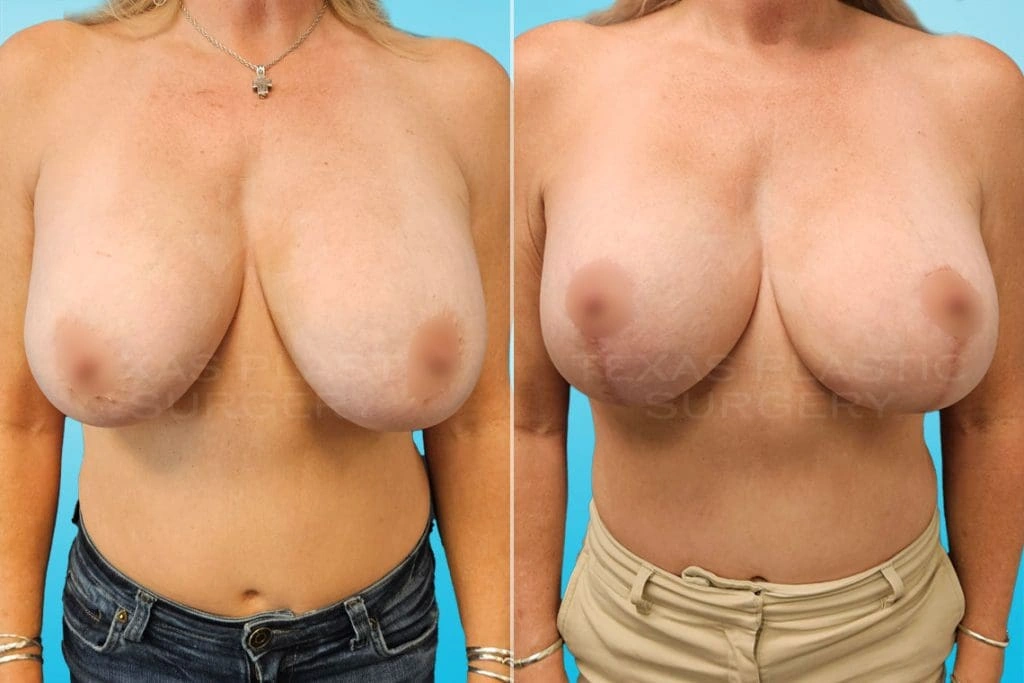
View Before & Afters
Contact us Today

